Wild Weather and Climate Change: Building Resilient Communities
Author: Nicole Milburn
Wild weather and climate change are interconnected, increasingly affecting U.S. communities through extreme events like heavy rain, snow, wind, heatwaves, droughts, wildfires, and landslides. As engineers, planners, landscape architects, and community members, what actions can we take to foster resilience?
Make a Plan, Work the Plan
Sustainable land-use practices balance ecological health, economic viability, and social equity while minimizing environmental impacts and enhancing resilience to climate change-induced natural disasters. Many AHBL projects involve community goal-setting and strategic planning for sustainable systems, fostering engagement and awareness. Involving communities in decision-making cultivates a sense of ownership and dedication to sustainability initiatives. This collaborative approach enhances disaster preparedness, helps identify vulnerabilities, and informs strategies to minimize damage from natural disasters like flooding and wildfires. Additionally, building codes and land development standards play a crucial role in ensuring homes, buildings, and other structures are more resistant to fire and extreme weather.
Recently, AHBL helped the City of Edgewood update its Comprehensive Plan. This update refined the community’s vision, goals, and policies to address current conditions and forecast housing needs from 2024 to 2044. Comprehensive plans serve as foundational documents that guide growth and development while considering impacts on the built and natural environments. AHBL led this effort on behalf of the City, incorporating an engagement strategy to ensure community input shaped the periodic update. The process involved presenting updates to the public, policymakers, and advisory groups, fostering meaningful participation.
Design for Green Infrastructure
Last year, AHBL authored an article about the future of stormwater management and its essential role in preventing urban flooding and protecting water quality.
A key component of building resilience is green infrastructure, which captures, conveys, and filters runoff. One important element is the bioretention cell, also known as a rain garden. These site features receive water from adjacent paved or planted areas and are designed to capture and absorb rainwater from smaller, frequent rain events—perfect for Seattle’s signature drizzle. Even during large storms, they provide crucial areas for water retention. Additionally, rain gardens help control runoff in aesthetically appealing ways by supporting native plants that filter pollutants and remove up to 80 percent of sediments during rains, providing localized stormwater and flood control. According to groundwater.org, “as a rule, native vegetation should be incorporated into a rain garden.” Native plants require no fertilizers and have deep root systems that improve water absorption and nutrient uptake more effectively than non-native species.
A notable example of this in action is the Pierce College Johnson Science Building. AHBL engineers designed the building’s roof downspouts to discharge into multiple rain gardens, serving both educational and aesthetic purposes while supporting the college’s STEM education program. These rain gardens integrate with the campus stormwater conveyance and detention systems, while the parking lot includes a bioretention system for water quality treatment. Stormwater is ultimately discharged into a nearby wetland, reinforcing natural hydrological cycles.
Site SPF+
In 2024, every U.S. state faced some degree of heatwave. Strategies like increasing tree canopy, incorporating drought-resistant native plants, and designing with natural resources in mind can help mitigate rising urban temperatures. Passive solar design—such as orienting buildings to maximize winter heat gain and minimize summer heat exposure—can also drastically reduce energy consumption.
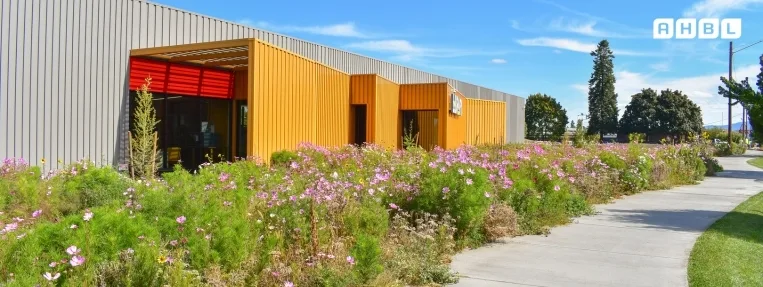
An example of sustainable design in action is the Spokane Valley Library. AHBL provided civil engineering, landscape architecture, and land-use planning for the new library. Strategically sited, the library features a wall of windows with generous glazing to maximize natural daylight and energy efficiency. The surrounding landscape includes a drought-tolerant meadow with native wildflowers and grasses, reducing maintenance and conserving water. The irrigation system uses subsurface drip irrigation to minimize water loss, while cast-iron tree grates with an underground root cell system support long-term tree health.
According to GlobalChange.gov, climate change impacts will continue to intensify unless carbon dioxide emissions reach net-zero levels. Net-zero carbon buildings (NZCBs) are designed to be energy efficient, powered entirely by renewable energy, and constructed or retrofitted with sustainable, low-carbon materials. Locally, the City of Tacoma’s Climate Action Plan has set an ambitious goal: by 2030, all new buildings must be constructed to meet net-zero standards. According to the U.S. Green Building Council (USGBC), buildings account for 41 percent of total U.S. energy consumption. Green building strategies, such as LEED certification, can significantly reduce carbon emissions and environmental impacts while improving quality of life. To date, AHBL has contributed engineering and landscape architecture services to over 75 LEED-certified projects and has 15 LEED-accredited professionals on our team.
Support for Emergency Services: A Critical Factor in Extreme Weather
During extreme weather events, emergency response is vital. Upgrading infrastructure can improve access for emergency vehicles and enhance disaster resilience.
For example, at Pierce College’s Johnson Science Building, AHBL’s civil engineers designed a new 100-stall ADA parking lot with emergency vehicle access. Existing concrete and Grasspave fire lanes were replaced to accommodate utility installations. The updated design includes vehicular concrete and Grasspave surfaces capable of supporting emergency vehicle loads while providing multiple access points and turnaround space. Our engineers also prepared a campus master development plan and provided pre-design services for this innovative project.
Making a Positive Change
As environmental regulations evolve, AHBL remains committed to leading in sustainable planning, engineering, and landscape architecture. We embrace our responsibility to contribute to the region through projects that promote environmental health, resilience, and long-term community vitality.