Designing for Everyone: Embracing Universal Design and Accessibility
Author: Nicole Milburn
According to the Centers for Disease Control and Prevention (CDC), one in five American adults lives with at least one kind of disability. Designing accessible infrastructure and inclusive spaces allows people of all abilities to experience environments in the same way, exercise independence, and connect with others in their community.
Incorporating Universal Design Principles from the Beginning
Universal Design (UD) benefits everyone. Coined by architect and planner Ronald L. Mace, UD emphasizes equality in design—not separate but equal spaces. According to Ron Mace, “Universal design is design that is usable by all people, to the greatest extent possible, without the need for adaptation or specialized design.”
His work has influenced national legislation, including the Fair Housing Amendments Act of 1988 and the Americans with Disabilities Act of 1990. As the concept of UD continued to take root, in 1997, a group of architects and researchers developed seven principles of UD:
· Equitable use
· Flexibility in use
· Simple and intuitive use
· Perceptible information
· Tolerance for error
· Low physical effort
· Size and space for approach and use
Successful UD projects consider and integrate topography, intuitive design, and inclusive mobility from the earliest planning stages. For example, a gently sloping ramp built in place of stairs equally serves everyone, including seniors and people with mobility challenges to parents pushing strollers.
A prime example of Universal Design in action is the Puyallup Pierce College STEM building. While the campus master plan, prepared during the planning phase, identified major pedestrian routes, AHBL’s civil engineering team contributed to the design of paved ADA-accessible routes around the building. These routes connect to existing accessible pathways leading throughout the campus. Additionally, a gravel path adjacent to the second-growth forest provides an opportunity for students, faculty, staff, and community guests to enjoy the forested areas surrounding the college.
Innovative Approaches to Accessibility
Today, AHBL always strives to meet ADA compliance standards. Through early planning and collaboration with engineers, architects, and landscape architects, we go beyond compliance to create more integrated, seamless designs. From higher education campuses to parks and essential service facilities, opportunities for universal design and ADA accessibility improvements exist everywhere. Key elements such as intuitive signage, wide sidewalks, ramps, and crosswalks ensure that going to school, visiting a park, or accessing community services is safe and effortless for everyone.
Examples of Innovative Approaches
Seattle Parks and Recreation: Magnuson Park’s Field 8, Mickey Merriam Field 5, and Delridge Playfields: AHBL’s engineers and landscape architects designed and documented the replacement of the synthetic turf fields, while also ensuring accessibility improvements for the playfields. By simultaneously addressing existing access issues the spectator experience is enhanced, allowing everyone to enjoy the field’s amenities.
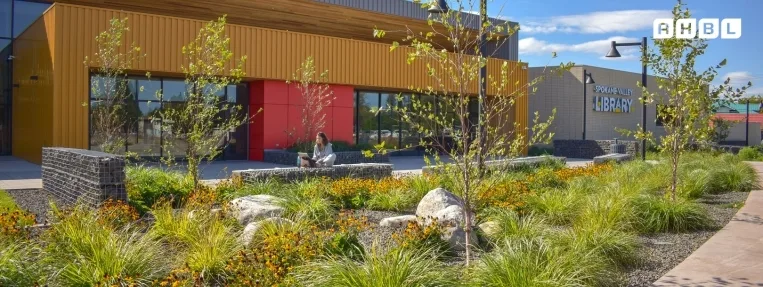
Spokane Valley Library and Balfour Park Campus: Starting with an undeveloped property adjacent to City Hall, AHBL partnered with the City of Spokane Valley and Spokane Valley Library District to create a cohesive, inclusive library-park campus. AHBL’s team provided civil engineering, land use planning, and landscape architecture services for both the library and park. The new library features automatic entry doors, accessible catalog computers, self-checkout stations, and information desks at varied heights. Outside, a wide, sweeping sidewalk now runs along an adjacent busy road and connects the library to Balfour Park via accessible pathways. The library-park campus creates an inclusive outdoor gathering space that welcomes people of all abilities.
Accessible Built Environments Benefit the Entire Community
We believe everyone deserves equal access to community resources and public spaces. AHBL’s commitment to staying informed on the latest mobility standards ensures that our new projects consistently exceed minimum compliance. By embracing Universal Design principles, we prioritize placemaking, community design, open space, and amenity integration that supports diverse users. Our land use planners, civil and structural engineers, surveyors, and landscape architects work collaboratively with our architectural teaming partners to create master plans that emphasize inclusion and equity.
We believe that all people deserve access to community resources and public spaces. From essential services like libraries and parks to educational campuses, our goal is to create safe, lively, and welcoming communities where all people can live, grow, and thrive together.
· What is Universal Design? – The UD Project