
Third Spaces: Designing Places Where Community Happens
By Maddie Olson
As our lives become increasingly digital, the value of places that bring people together outside of home and work is rising in equal measure. Often called “third spaces,” these environments offer something essential: the opportunity for genuine human connection.
For Craig Andersen, PLA, AHBL’s Director of Landscape Architecture for Eastern Washington, third spaces are less about trends and more about instinct. “People want to be somewhere where they have the potential to interact with other human beings,” he says. “They don’t want to be stuck in a cubicle or at home distracted by laundry and everything else.”
Libraries, farmers markets, plazas, and shared outdoor spaces have long served this role, but today they are being reimagined to meet changing social, environmental, and economic needs. From Craig’s perspective, the purpose hasn’t changed, but the expectations have.
The DNA of a Successful Third Space
From a design standpoint, Craig notes that the fundamentals of lively public space were identified decades ago and still hold true. Referencing the work of urban sociologist William H. Whyte, he explains that people gravitate toward spaces with comfort, flexibility, and activity. “People are looking for a good environmental comfort level, movable seating, and multiple seating arrangements—from individual to group to large group,” he says.
Equally important is what he describes as the “sense of place,” which emerges from the interaction between the environment, the people, and the activity happening there. Spaces that succeed over time offer reasons to return, whether that’s programming, art, food, or simple opportunities for interaction. “These spaces can be passive or very active,” Craig explains, “but something needs to create change and interest over time.”
Transforming an Industrial Past into a Community Hub
That philosophy comes to life at the Spokane Conservation District’s 50-acre conservation campus, a former asphalt plant and quarry reimagined as a center for sustainability, innovation, and public life. Working alongside Integrus Architecture, AHBL developed the site’s master plan and supported multiple phases of redevelopment.
Phase I delivered a 12,400 SF office and training center topped with rooftop solar panels, followed by a Phase II 15,000 SF partnership building housing the Washington Small Business Development Center. In Phase III, the historic Scale House was transformed into the region’s first year-round farmer’s market.
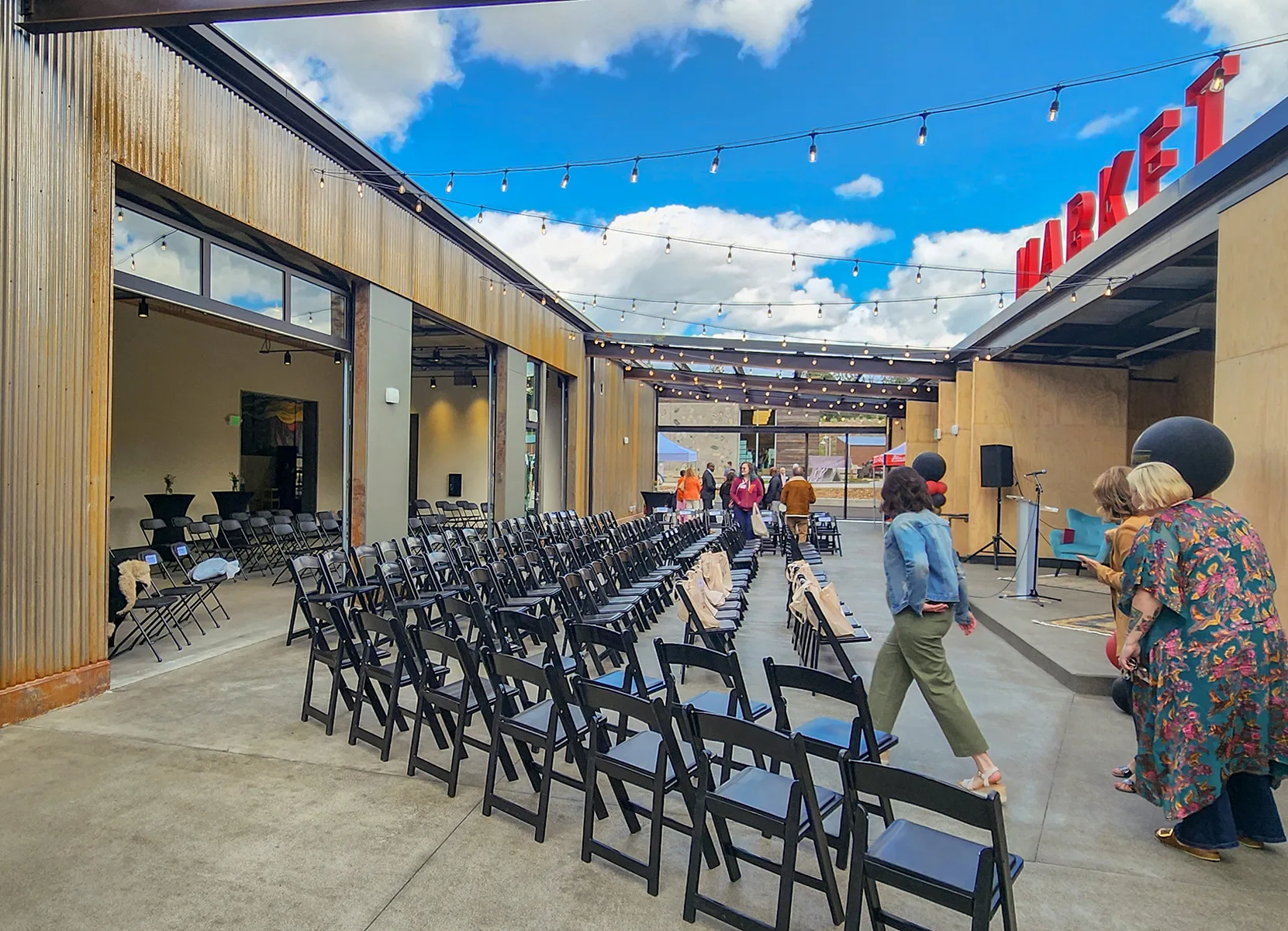
For Craig, the success of the project lies not just in the buildings, but in the spaces between them. “On the Scale House project, we created a multipurpose patio space between the market and the Phase II building,” he says. “It serves as spillover for the farmers market, with room for vendor tents, food trucks, or a mobile coffee stand.”
The patio was designed to adapt to a wide range of uses, from everyday seating to movie nights and large gatherings. Semi-fixed seating provides structure, while movable tables and chairs allow the space to be reconfigured as needed. “The goal was to offer flexibility without making it feel like a big, empty plaza when no one’s there,” Craig explains.
Across the campus, AHBL’s civil engineering and landscape architecture teams worked together to honor the site’s industrial history while embracing sustainability. Native vegetation, solar analysis, and repurposed materials reflect the land’s story while supporting long-term resilience—an approach that earned the project multiple awards and deepened its connection to the Spokane community.
Libraries as Modern Civic Living Rooms
Libraries are another clear example of how third spaces are evolving. AHBL’s work on the new Spokane Valley Library reflects a shift from quiet, single-purpose buildings to flexible, community-centered campuses.
The 28,000 SF single-story library features an open floorplan designed to adapt over time, with space for up to 200 people, six conference rooms, a large children’s area, and an audio/visual studio available for public use. But Craig emphasizes that the indoor spaces are only part of the story.
“Outdoor spaces are critical,” he says, pointing to how the community room opens directly onto a patio and children’s reading lawn that borders Balfour Park. AHBL’s landscape architecture team coordinated an integrated layout that blends the library grounds seamlessly with the park, encouraging people to move easily between indoor and outdoor environments.
The campus also introduced Spokane Valley’s first prairie restoration and meadow landscape, featuring drought-resistant native grasses and wildflowers selected to reduce water use and maintenance demands. “Those choices matter,” Craig notes, especially as budgets tighten and maintenance cycles stretch longer.
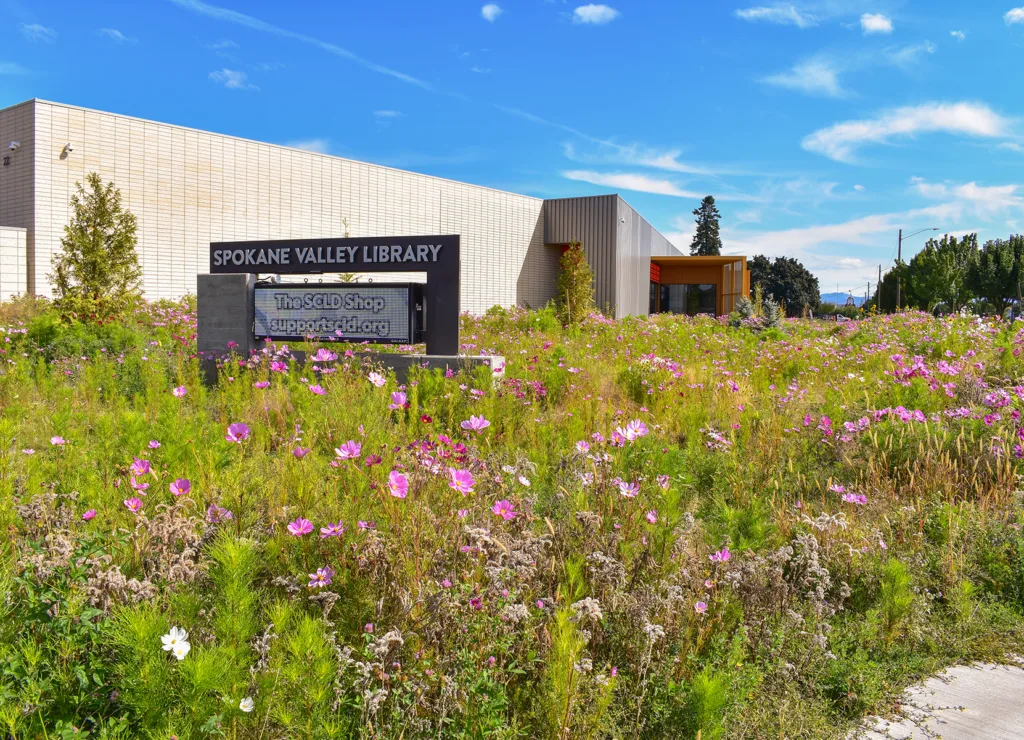
Pedestrian circulation and safety were central to the design, with arcing trails connecting the library to adjacent park space, traffic-calmed site circulation, and clear wayfinding. The result is a library that functions as both a destination and a connector—an everyday gathering place woven into the surrounding neighborhood.
Designing for Inclusion and Belonging
For Craig, designing inclusive third spaces isn’t a separate initiative, it’s a fundamental responsibility. “When outdoor spaces are designed for all ages and abilities,” he says, “they naturally work better for everybody.”
He points to simple but meaningful elements, such as benches with backs and armrests, which support older adults and people with mobility challenges, while also providing comfort and a sense of security for those experiencing trauma or PTSD. “We think a lot about trauma-informed design,” Craig explains. “Even small details can help people feel safer and more at ease.”
These considerations extend to projects that serve vulnerable populations, where visibility, dignity, and comfort must coexist. Rather than hiding certain users, well-designed third spaces allow people to be present and engaged in ways that feel safe and respectful for all.
Flexibility, Durability, and the Future of Third Spaces
Flexibility, Craig explains, is baked into successful third spaces from the beginning. “You look at the maximum population, the average daily use, and then design so the space works at every scale,” he says. Movable furnishings, adaptable layouts, and durable materials allow spaces to evolve without constant reinvestment.
As funding and maintenance resources become more constrained, AHBL increasingly prioritizes materials that can perform for decades. “We’re often designing for 30- to 50-year capital improvement cycles,” Craig notes, “knowing that maintenance may be minimal or infrequent.”
Looking ahead, Craig believes third spaces will continue to grow in importance, particularly for younger generations. “These places are becoming the real nexus of where people gather,” he says. “You can meet friends, get something to eat, attend an event, check out a book—it’s all connected.”
When thoughtfully designed, third spaces do more than fill the space between home and work. They become places where people feel seen, welcomed, and part of something larger—places where community doesn’t just exist, but actively happens.
Our experts are ready to provide insights and develop tailored strategies. We’ll help you move your project forward with confidence.