
On the Front Lines of Electrification: Civil, Structural, and Electrical
By Maddie Olson
Featured Image Credit: Doug Walker
Electrifying new and existing buildings is central to many jurisdictions’ climate goals. It promises lower carbon emissions, cleaner indoor air, and the chance to pair buildings with renewable energy. But on active projects, the shift is reshaping coordination, footprints, and budgets. Perspectives from a civil engineer, a structural engineer, and an electrical engineer help illustrate what’s changing on the ground and what design teams should plan for next.
Electrification is advancing, but it’s not a simple one‑for‑one replacement. Civil teams are solving EV stall siting, grading, and conduit conflicts; structural teams are integrating solar without compromising roofs; and electrical teams are upsizing services and rethinking transformer placement. The throughline: start coordination earlier, make room for equipment and clearances, and be transparent about cost and space impacts.
Civil: EV stalls change site planning, not just striping
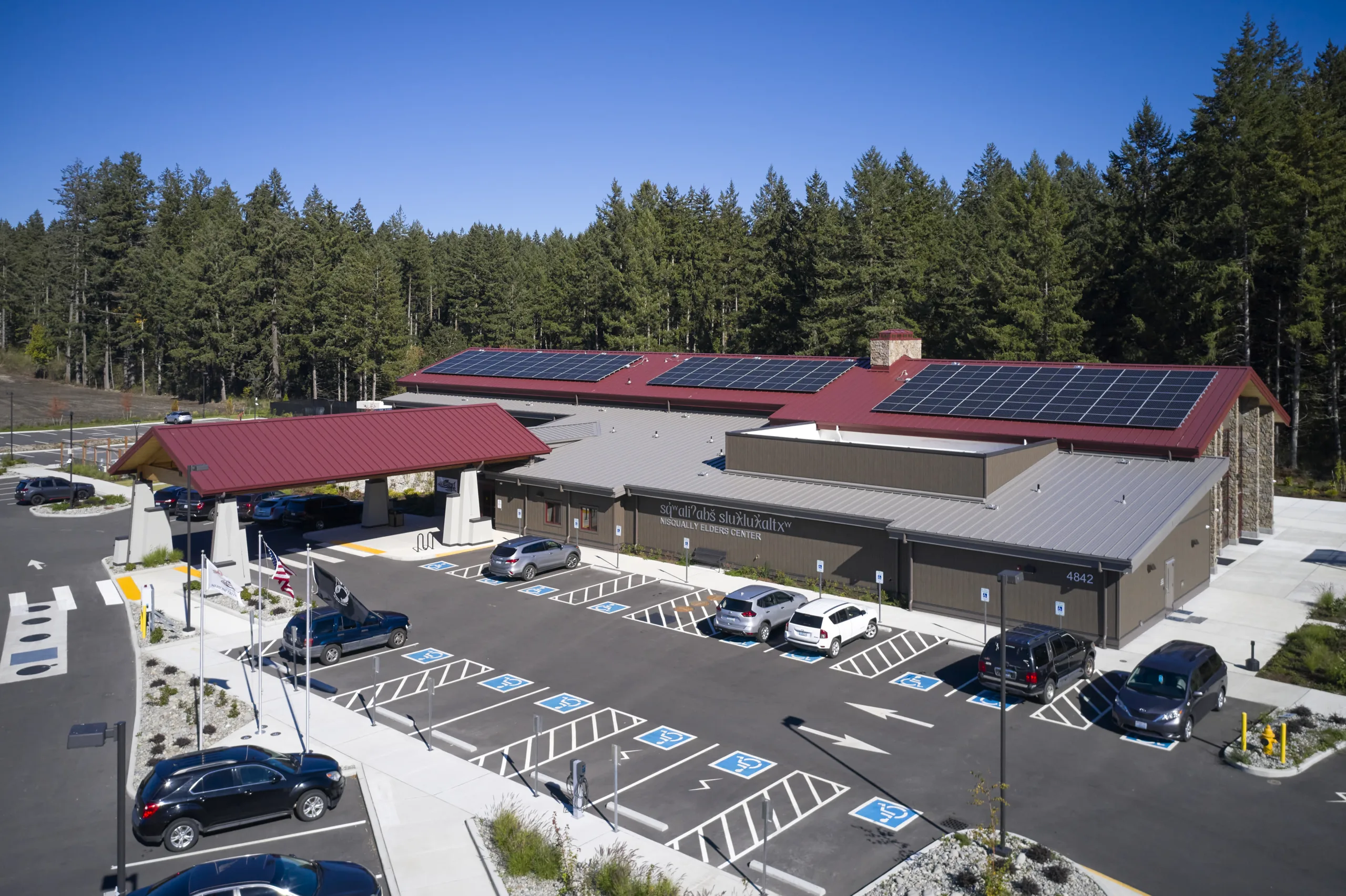
AHBL engineers agree that EV‑ready and EV‑installed stalls don’t simply “drop in.” They drive early site decisions, including electrical routing and ADA clearances at sidewalks.
“There are code requirements for where EV stalls need to be, but owners also want them close to existing power,” said Todd Sawin, PE, civil engineer and AHBL Principal. “Overlaying those goals with stall grading, clearances, and sidewalk widths can be challenging. The chargers and pedestals take more space than a typical stall, so you need to make those adjustments early.”
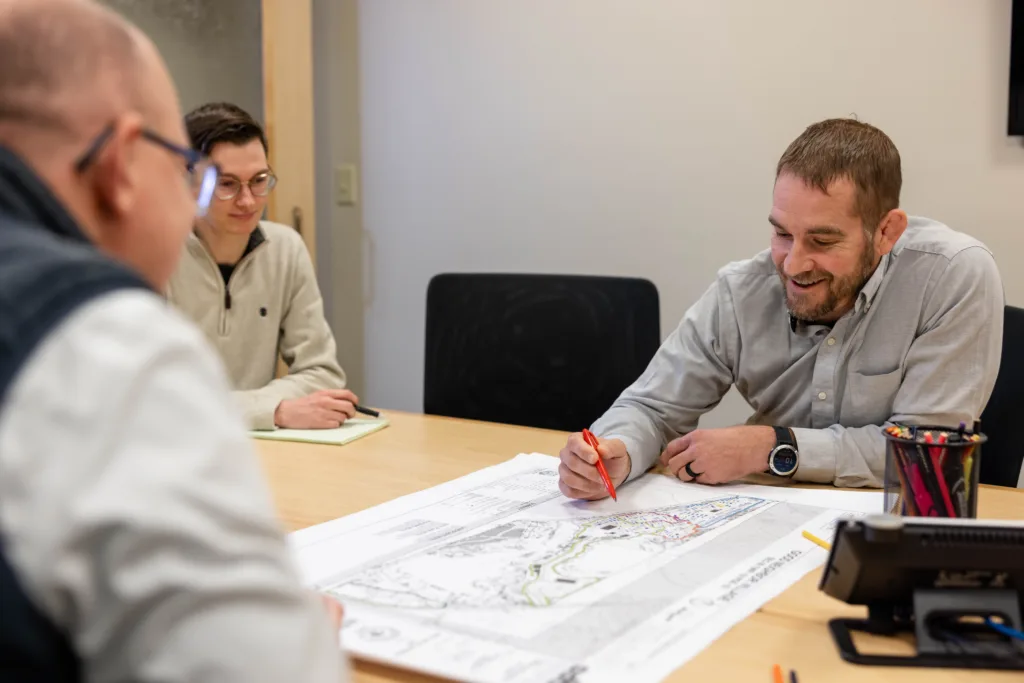
Contractors once handled many of the conduit placements in the field, but with public bid requirements, engineers must note the conduit placement on final plan sets. “On some smaller sites, contractors still work it out during construction,” Sawin said. “But on public work, we must show the conduits and all the crossings.”
Another shift: civil drawings now contain more precise electrical information than they used to. “Electrical drawings can stay at ‘design intent’ longer,” Sawin noted. “Civil engineers are taking on more exact locating of surface features and routes, and using notes to give contractors some flexibility, like calling out minimum clearances instead of fixed dimensions, so they can work around conflicts during install.”
As EV adoption increases, parking lots are starting to look different. Sawin explained that in the past, parking areas could be sloped to help manage grade changes across a site—essentially using the natural incline of a parking lot to transition from one elevation to another. But EV charging spaces must be nearly level to meet accessibility requirements and to ensure chargers function safely. “When a larger portion of parking has to meet these stricter standards, we can’t rely on sloped parking to resolve grade differences anymore,” he said. “That means more flat areas, more retaining or transition walls, and more effort to ‘build’ a flat plane on naturally sloped ground. It pushes us toward different grading solutions than we’ve used before.”
Structural: PV is the bigger story than fuel source
Electrification itself hasn’t radically changed structural design, according to Andrea Sauter, PE, SE, a structural engineer and AHBL Senior Associate.
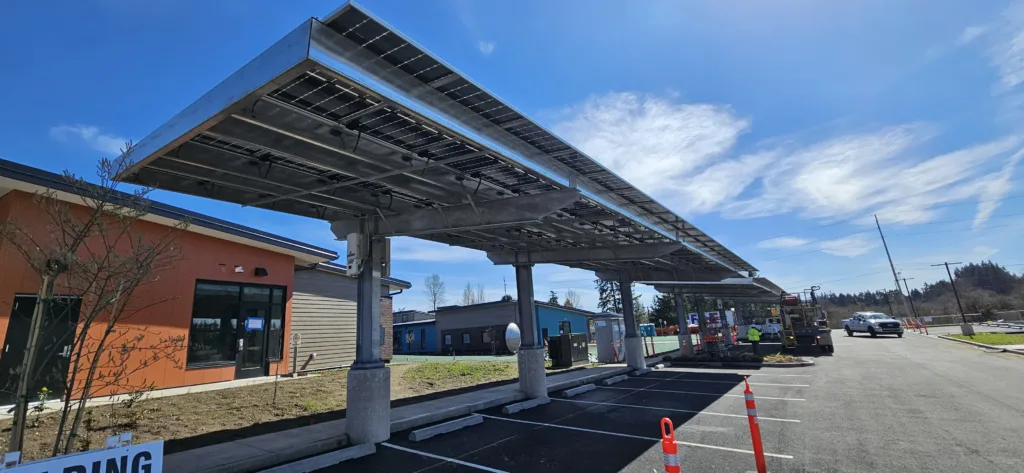
“On commercial projects, we often see similar mechanical units, just a different energy source, so our loads and anchorage aren’t dramatically different,” she explained. “Where we do see more change is solar. PV has become one of the most economical paths to meet energy credits, so we’re seeing it on nearly every project.”
For owners, the critical decision is how much photovoltaic (PV) to integrate now versus leaving “solar‑ready” capacity for later. “It’s an owner‑driven conversation,” Sauter said. “Some aim to maximize generation and seek grants to cover full‑roof arrays. Others see panels as a maintenance burden and opt for the minimum plus the required solar‑ready set‑aside.”
The risk many teams underestimate isn’t the weight of the panels; it’s wind uplift. “People think, ‘they’re light; just clip them on.’ But wind uplift forces often control the anchorage requirements. There are special code provisions for wind loads on PV arrays, and the focus in design is making sure panels don’t get blown off the roof,” Sauter said. Early design build (DB) collaboration with PV vendors helps: “If we know the racking and attachment early, we can design our components for wind and seismic with fewer surprises.”
Looking ahead, she expects more standardization. “Right now, there’s no single dominant racking approach. I think certain systems, especially ones that minimize roof penetrations, will become the default. Owners hate adding hundreds of penetrations to a roof, so solutions that reduce that risk will become more prevalent.”
Electrical: bigger services, closer transformers, clearer budgets
Electrification plus EV charging requirements quickly adds up at the service entrance, said Sean Roy, LC, an electrical engineer and Principal at Tres West Engineers.
“EV code percentages directly affect service size. According to the Washington Administrative Code, new construction Business occupancy buildings must provide 10% of total parking spaces with EV charging stations, 10% of total parking spaces with EV-Ready infrastructure, and 10% of total parking spaces allocated for EV-Capable stalls. On a new site with 100 parking stalls, you’re planning for 30 chargers’ worth of load. At roughly 40 amps per charger, that’s about 800 amps dedicated to EV capacity for 10 fully operational EV charging stations. When designers conservatively account for future expansion or limited diversity, that load can grow quickly—driving upsizing of the switchboard, transformer, secondary conduits, and even the electrical room footprint.”
Those amps translate to real dollars. “Going from a 2,000- to a 3,000-amp switchboard means more conduits to the transformer and a bigger room. The owner pays for those secondary conduits, and adding just 50 feet can cost an additional $40–50K. So, generally, we push to get the transformer as close to the building as possible, while still meeting clearance and access requirements.”
Early meetings with utility companies help ensure the design is realistic. “We meet in the field before design, give them loads and site drawings, and then incorporate their engineered layout after design development. Planning transformer placement early keeps surprises down later.”
On project delivery, Roy sees advantages to Progressive DB (PDB): “With the contractor, engineers, and owner working in the model together, we can find pathway conflicts and cost drivers before bid. It keeps budgets honest and field changes down.”
As for backup systems, batteries remain a tough sell. “Grid‑scale batteries are massive, expensive, and require ventilation. When owners compare costs, many still pick generators,” Roy said. He also points to funding shifts: recent changes to federal incentives have cooled parts of the residential solar, battery, and EV market. “We’ll adapt as policies evolve, but for now, electrification adds load and cost that must be planned for from day one.”
What A/E teams can do now
- Consider EV siting during concept design. Lock down where and how chargers, pedestals, and sidewalks work together. Plan conduit crossings around utilities early.
- Right‑size electrical rooms early. Service size, panel footprint, and transformer location drive budget and routing. Consult with utilities before design development.
- Treat PV as part of the structure. Coordinate racking and attachment early and discuss roof penetrations with owners.
- Use delivery methods that minimize risk. PDB and shared models reduce clashes, cost surprises, and field changes.
Electrification is here, and it works best when teams plan for the space, weight, and power it truly requires. The payoff is cleaner buildings and a clearer path to future‑ready sites. But as the engineers doing the work point out, the details make or break the outcome: coordinate early, design precisely, and keep the conversation practical.

Our experts are ready to provide insights and develop tailored strategies. We’ll help you move your project forward with confidence.