
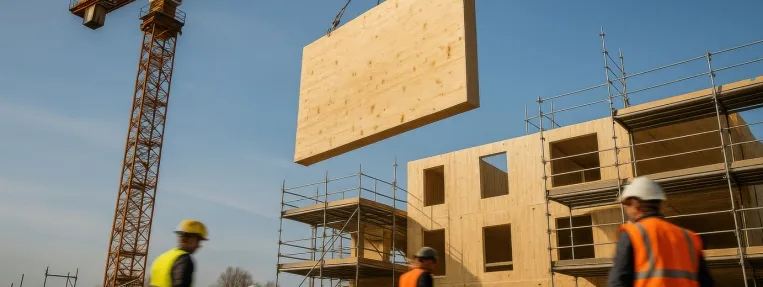
Modular Construction: A Scalable Path to Building Affordability
Author: Denise Storaasli
As the demand for affordable housing continues to outpace supply, the construction industry is being pushed to rethink not just how we build—but how we design. Modular construction has emerged as a powerful solution, offering speed, efficiency, and cost savings. But its true potential lies in how it reshapes the design process itself.
Modular construction involves making parts (or modules) of the buildings in the factory first as opposed to other building types. Once the modules are ready, they are transported to the building site and then assembled. Often the results are faster and often less expensive than building everything from scratch on-site.
Design firms like AHBL have seen the benefits of Design-Build and other alternative delivery methods. With modular construction, we also integrate the manufacturers at the start of the project, like the process in the Design-Build project approach. By integrating design with manufacturing from the outset, modular construction enables scalable, repeatable, and adaptable building solutions—without sacrificing quality or creativity. It’s a shift that’s not only making residential structures more affordable, but also smarter, more sustainable, and better suited to the diverse needs of today’s communities.
Modular construction doesn’t just change how we build—it transforms how we design.
In traditional construction, design and build phases are often siloed, which can lead to inefficiencies, delays, and cost overruns. Modular construction flips that model by requiring a more integrated, collaborative approach from the start. Architects, engineers, and manufacturers work together early in the process to create repeatable, scalable designs that can be adapted for multiple sites; lowering overall costs of the build and eliminating waste which is better for the environment.
This shift has several key impacts:
- Standardization with Flexibility: Modular design encourages the use of standardized components, which reduces costs and speeds up production. But it doesn’t mean cookie-cutter buildings—designers can still incorporate variations in layouts and aesthetics to reflect local character and community needs.
- Design for Manufacturing and Assembly (DfMA): Our structural engineers design in close collaboration with architects but also keep the factory in mind. This means simplifying forms, optimizing materials, and ensuring that every element can be efficiently produced, transported, and assembled—without sacrificing aesthetics or livability. It can also mean sourcing from local suppliers to reduce impacts to the environment and carbon footprint.
- Sustainability by Design: Modular construction naturally supports greener design. With tighter tolerances and less waste, designers can more easily integrate energy-efficient systems, passive design strategies, and sustainable materials.
- Faster Iteration and Prototyping: Digital tools like BIM (Building Information Modeling) allow for rapid prototyping and testing of modular designs. This speeds up approvals, reduces errors, and enables more innovation in affordable housing design.
Ultimately, modular construction empowers designers to think more strategically about scale, efficiency, and impact—without compromising on quality or aesthetics. It’s not just about building faster and cheaper; it’s about designing smarter, more resilient communities.
AHBL partners regularly with area architects to design affordable housing projects in Western and Eastern Washington. Our teams routinely design modular systems for community buildings such as: the Chamber’s Bay Golf Course Clubhouse; modular schools for Tacoma Public Schools, and Tacoma Parks W.W. Seymour Botanical Conservatory—a 6,000 SF production greenhouse all used modular design and construction.
Sources:
Our experts are ready to provide insights and develop tailored strategies. We’ll help you move your project forward with confidence.